
AUGUST 2026 | Industry News
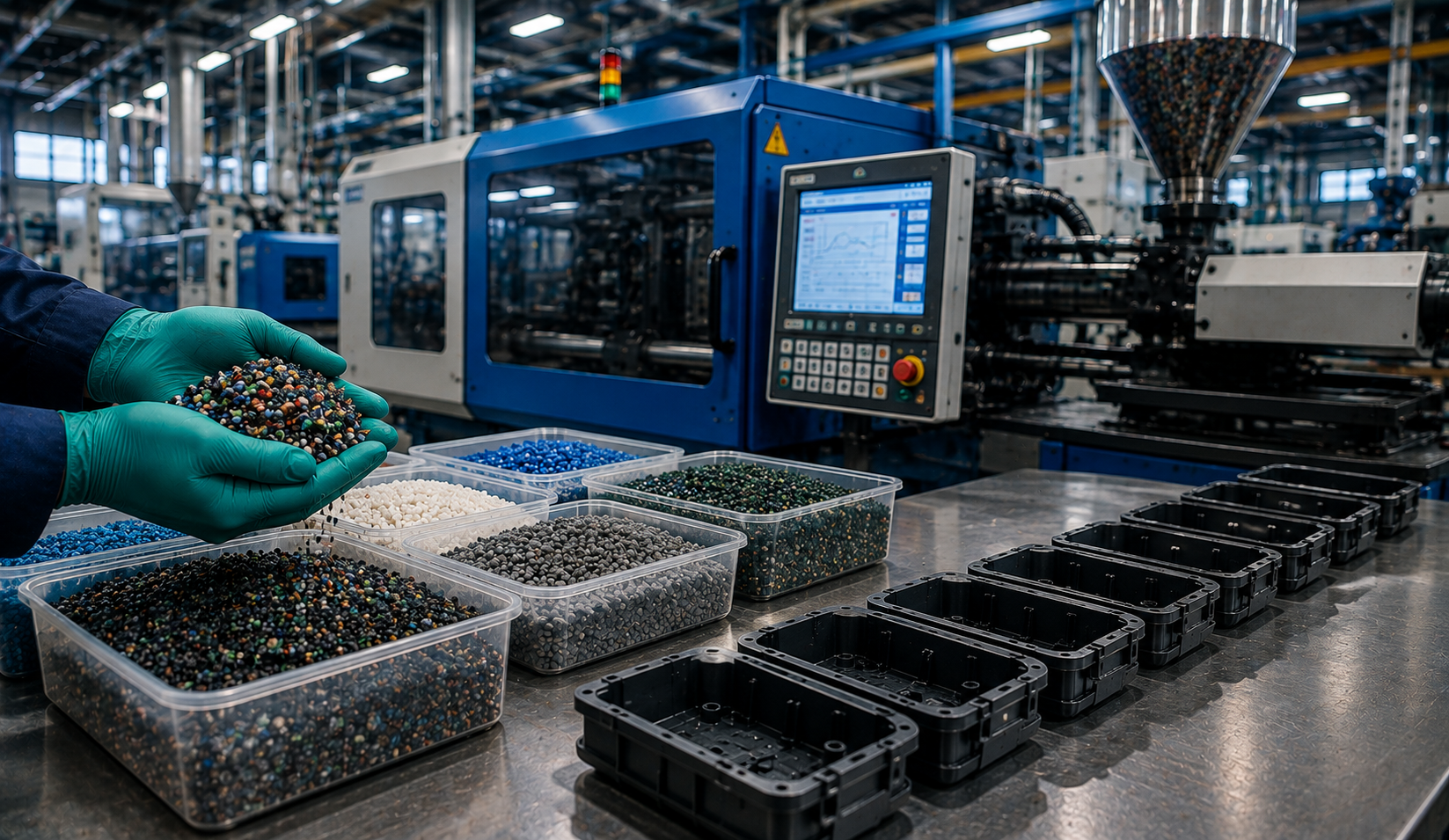
At first glance, incorporating recycled material into injection molding may seem like a simple raw material substitution. In production, however, the challenge is more complex: how do you maintain consistent parts when the resin may not behave exactly the same from one batch to another? Unlike virgin resin, which typically offers more controlled properties, post-consumer recycled (PCR) thermoplastics can exhibit variations related to composition, contamination, and previous degradation. Recent research indicates that these differences can affect material behavior during processing and require ongoing adjustments to maintain consistent part quality.
When the Material Changes, the Process May Need to Change Too
Variables such as flow behavior, viscosity, moisture content, and thermal behavior influence how the polymer fills the cavity and responds to machine parameters. One study examining recycled PP fractions found considerable differences in melt flow rate between batches, ranging from approximately 15 to 31 g/10 min. This variation led researchers to emphasize that processing conditions should be carefully defined when working with recycled materials. Even repeated processing cycles can alter the polymer. Studies involving polypropylene have shown that repeated exposure to heat and shear can affect polymer chains and change the material’s flow behavior.
From Fixed Parameters to an Adaptive Process
This is where one of the most interesting trends of 2026 comes into play: enabling the process to respond to material variability. Researchers have developed systems that use cavity pressure, predictive models, and machine learning to adapt parameters during the molding of PCR thermoplastics. A study published in June 2026 even proposes updating the control model after each cycle to help maintain consistent part mass as material batches change. For manufacturers, the message is clear: incorporating recycled resin is not simply a matter of changing the material in the hopper. It requires understanding the material, measuring its behavior, and recognizing the relationship between resin, machine, mold, and process parameters. Circularity continues to advance. The next challenge is making it repeatable in production.
Consistency Is Built Throughout the Entire Process
Working with recycled materials introduces new variables, but it also opens the door to increasingly intelligent processes. When resin, mold, machine, and production parameters work together, understanding each component becomes essential. If you are evaluating molds or machinery for your upcoming injection molding projects, talk to the Molds Unlimited team and explore the options available for your operation.