
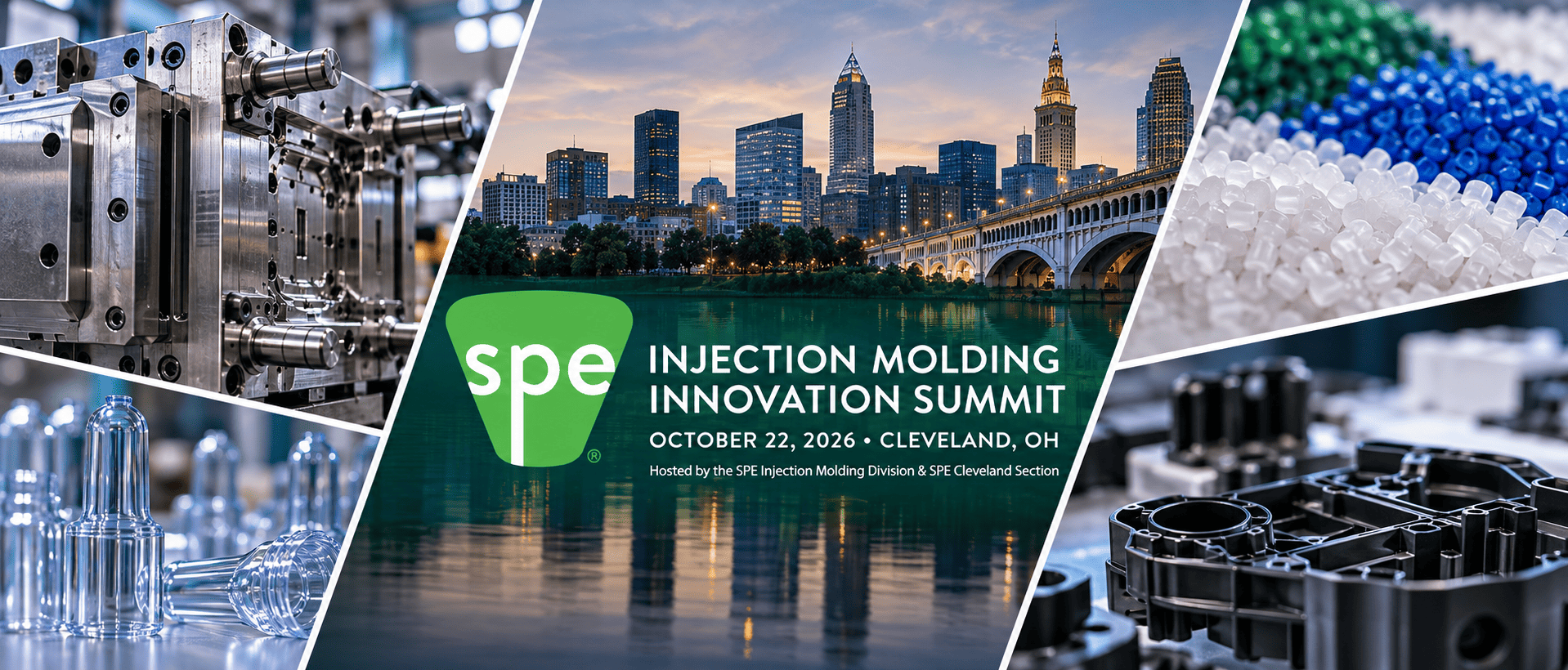
An injection molding conference can look like a parade of new technologies. For plant leaders, the more useful question is practical: which ideas could reduce scrap, improve part consistency, or lead to a smarter equipment decision? Scheduled for October 22 in the Cleveland area, the Injection Molding Innovation Summit 2026 offers several ways to examine those challenges.
Technology matters when it solves a production problem
SPE’s published agenda brings together several areas that are worth evaluating separately: • Process control: AI-driven tools designed to analyze and adjust variables. • Mold trials: software-assisted approaches that can support evaluation during testing. • Materials: characterization work that helps manufacturers better understand resin behavior. • Cooling: optimization of a stage that directly affects cycle stability. Before investing in a new capability, manufacturers should ask what variation it can reduce, what data it requires, and whether operators can use it during an ordinary shift. A successful demonstration is not the same as a repeatable production improvement.
Tooling and materials still determine the outcome
Automation does not replace the fundamentals. Inadequate cooling can limit cycle stability, while a resin change can affect shrinkage, surface finish, or filling behavior. Equipment and tooling decisions therefore need to consider the part, production volume, material, tolerances, and available plant capacity together. Even a pre-owned solution can make sense when compatibility is established and its condition is properly assessed. That judgment takes more than comparing purchase prices. The published program also covers workforce development and economic trends. That combination is a reminder that productivity is not solely an equipment issue. A plant may own advanced machinery and still lose efficiency through undocumented adjustments, inconsistent training, or poor visibility into scrap costs. After a technical event, each promising idea should become a limited trial with an owner, a timeline, and a way to measure results. Only then can the team determine whether a larger investment makes sense.
Bring the useful ideas back to the plant
A practical way to follow the summit is to identify three existing production challenges before reviewing the presentations. Quality variation, cycle time, and workforce training are possible starting points. Each new concept can then be measured against a specific operational goal and realistic budget. Molds Unlimited helps buyers think through the connection between molds, machinery, and manufacturing requirements. The goal is not to chase every trend. It is to identify equipment that can consistently produce the right part.