
A cap, a shampoo bottle, and an automotive bumper may all share the word “plastic,” but inside a plant they belong to very different worlds. Shape, wall thickness, size, material, and expected volume determine how each part should be made. That is why asking for “a plastic machine” is a little like asking for “a metal tool”: most of the story is still missing.
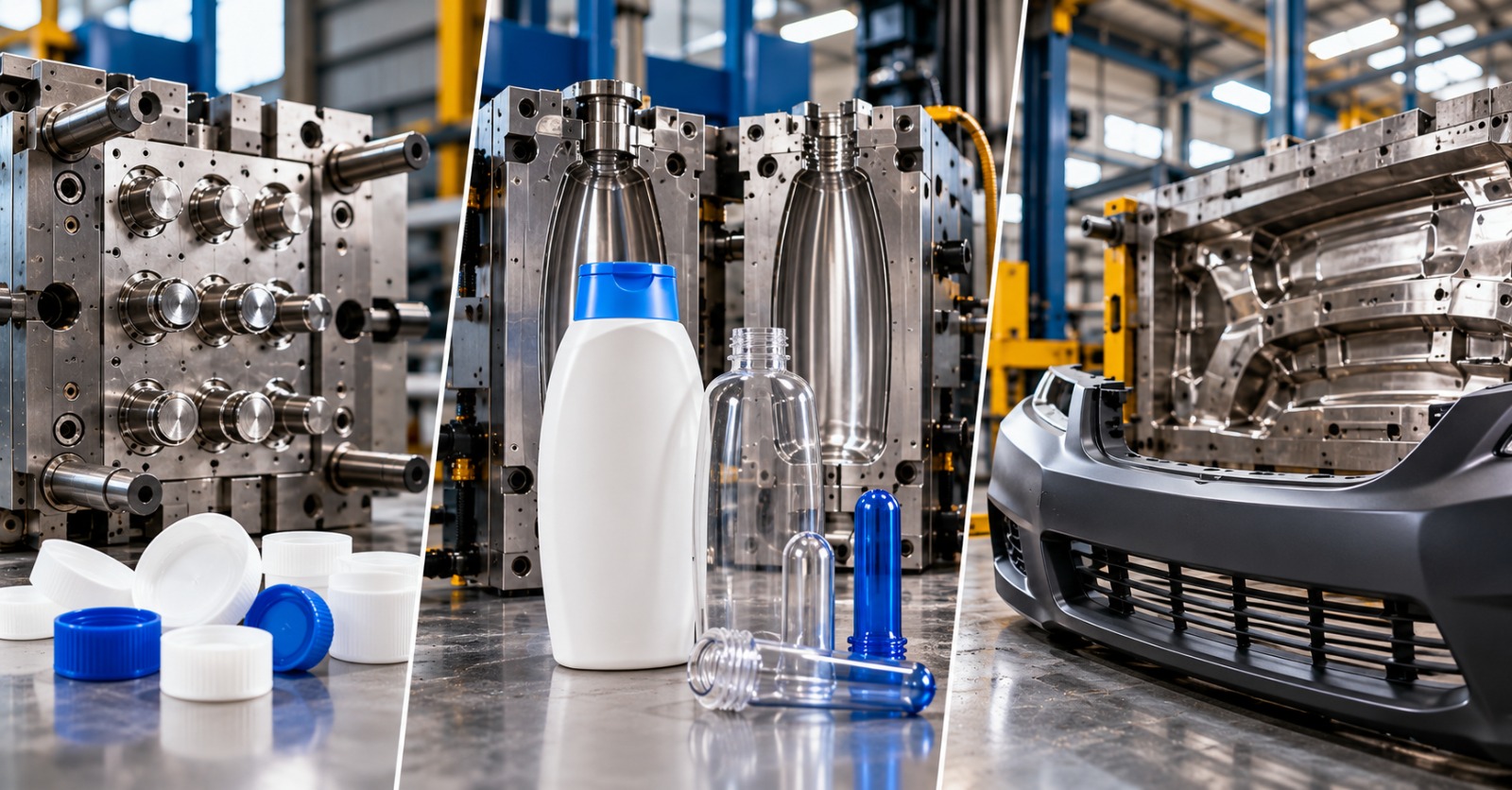
A cap: small, solid, and highly repeatable
Many caps and solid components are made through injection molding. Melted material is pushed under pressure into a cavity, takes the mold geometry, cools, and exits as a finished part. The process can produce detailed shapes at high repeatability and speed.
The mold defines cavities, runners, cooling, and ejection, while the machine must provide enough clamp force and injection capacity for the job.
A bottle: air becomes part of the process
Many hollow containers are made through blow molding. Instead of completely filling a cavity with molten material, a tube or preform is created and air expands it against the mold walls.
That is why a bottle and its cap, even though they end up in the same finished product, may require entirely different processes, molds, and machines.
What about a bumper? Size changes the equation
A large automotive component may still be injection molded, but at a very different scale. Projected part area, material, and geometry influence clamp tonnage, platen size, and the amount of material the machine must handle.
The word “injection” alone does not tell you whether a 50-ton machine or a machine in the hundreds of tons is appropriate. The part and mold tell the rest of the story.
The finished product is the best starting point
Before searching for machinery, start with the part: Is it hollow or solid? What are its dimensions? Which material will be used? How many units are required? What finish and tolerances matter? Those answers quickly narrow the possible processes.
Molds Unlimited works with injection molds, blow molds, and machinery for the plastics industry. If you are evaluating a project, understanding how the part needs to be made helps prevent one of the most expensive purchases: an asset that simply does not fit the job.